Internship · Zyp, Inc. · August – September 2026
Zyp
Zyp's public website, built and launched in four weeks: a hero you scrub with the scroll, a globe drawn on a canvas, and the tests that let it keep changing.
See it live (opens in a new tab)
The site
In August 2026 I joined Zyp, a company that moves money across borders for outsourcing businesses, to build its public site, www.zyp.co.
Zyp's product team builds the platform itself; the public site was my part. It went from an empty repository on 16 August to production on 13 September, and I kept shipping for a week after. Seven parts follow, each named for what it is.
The brief
One job for the page
The page has one thing to do: get a visitor to book a demo. The visitors run outsourcing, staffing and consulting businesses that pay people across borders. They evaluate the site before they ever speak to anyone, often forward it to a partner who arrives with no context, and a good share of them arrive on a phone. Zyp moves their money, so the page has to read as trustworthy before it reads as clever.
So the motion supports the content and never competes with it. Before the first line of animation I wrote the rules the whole build was reviewed against, thirteen of them. These six did the most work.
- One animation loop on the page, and it idles at 0 Hz when nothing subscribes.
- GSAP writes numbers into shared state; the renderers draw on their own tick.
- Exactly one pinned scroll trigger. Reveals are opacity and transform, 200–400 ms.
- No scroll hijacking and no smooth-scroll library: the scroll is the reader's.
- The headline and Book a Demo render on first paint, never behind a loader or an animation.
- Under 768 px and under reduced motion, a photograph: zero animation bytes.
Four weeks
From first commit to launch
- Stages
- 36
- Pull requests
- 67
- Commits
- 510
- Days to launch
- 28
- Scaffold Astro 7, every section's real copy, the motion manager, the first scroll-driven sequence on placeholder frames.
- Real frames The responsive AVIF and WebP frame pipeline; decoded-frame memory bounded to a sliding window.
- The dive Production frames, the product-video takeover at the end of the hero, the lower page, the first accessibility pass.
- The stutter A scroll stutter traced to decode starvation; a direction-aware, byte-budgeted decode window and a WebP scrub path.
- Fifteen pull requests The liquid-glass header, the studio theme, the canvas globe, the Playwright suite with axe, in one day.
- Launch The production origin set to www.zyp.co and the build cut from 21 pages to 9.
- Last pass The loader, the Trusted-by cylinder, the films and the look, after a client call.
Motion
How the hero was made
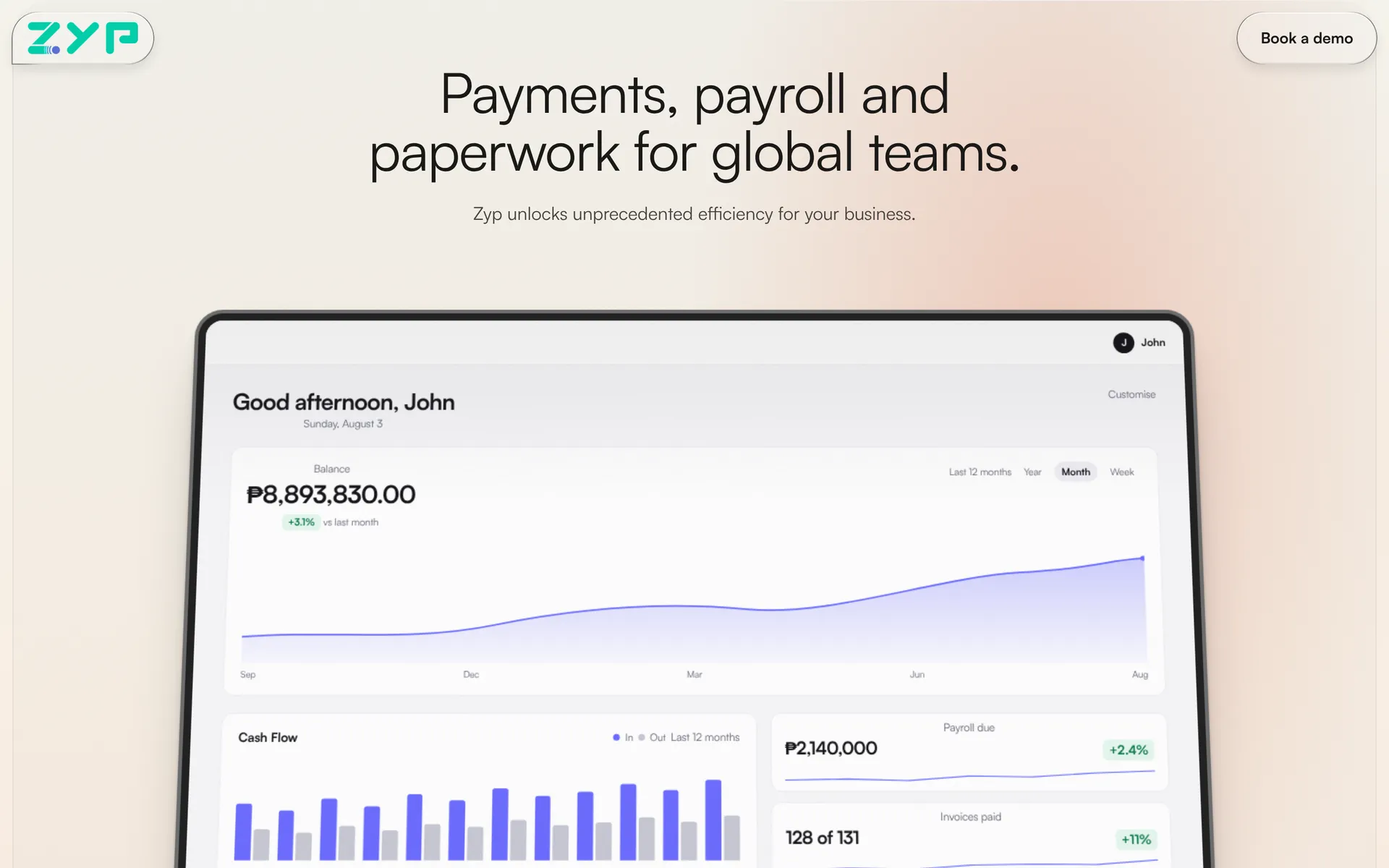
The home page opens on an office, and the scroll is the playhead: reading down pushes the shot in from the room to the laptop on the desk, scrolling back up plays it in reverse, and at the end the laptop's screen becomes the product video. The reader sets the pace. Getting there was a pipeline, not a video file.
- One photograph The office, shot once. The hero needed a camera move the photograph did not have.
- A camera move A generated push-in from the room to the laptop: steady, one direction, the screen blank, the last frame frontal with the screen full-bleed.
- 192 frames The take cut to frames with ffmpeg, then resampled to the 97 that ship, so the sequence spans the whole move.
- The screen, tracked OpenCV finds the laptop's screen on frame one and follows it through the take with a sub-pixel fit, 0.27 px of jitter at the 90th percentile, and warps the live dashboard onto it.
- A decode window The frames decode a few ahead of the scroll in the direction it is going, inside a byte budget: peak decoded memory went from 995 MB to 149 MB.
- 1
-
 20
-
 40
-
 60
-
 80
-
 97
3D
The canvas globe
Under the heading “Coverage where it matters”, the page draws a globe on an HTML canvas: no WebGL, no 3D library. The land comes from Natural Earth through d3-geo at build time and is drawn as dots in depth buckets; the payment arcs lift off the surface and are hidden where the sphere is in the way; a drag turns it. A frame draws in about 1.3 ms, and the globe mounts only when it is near the screen.

The page
The rest of it
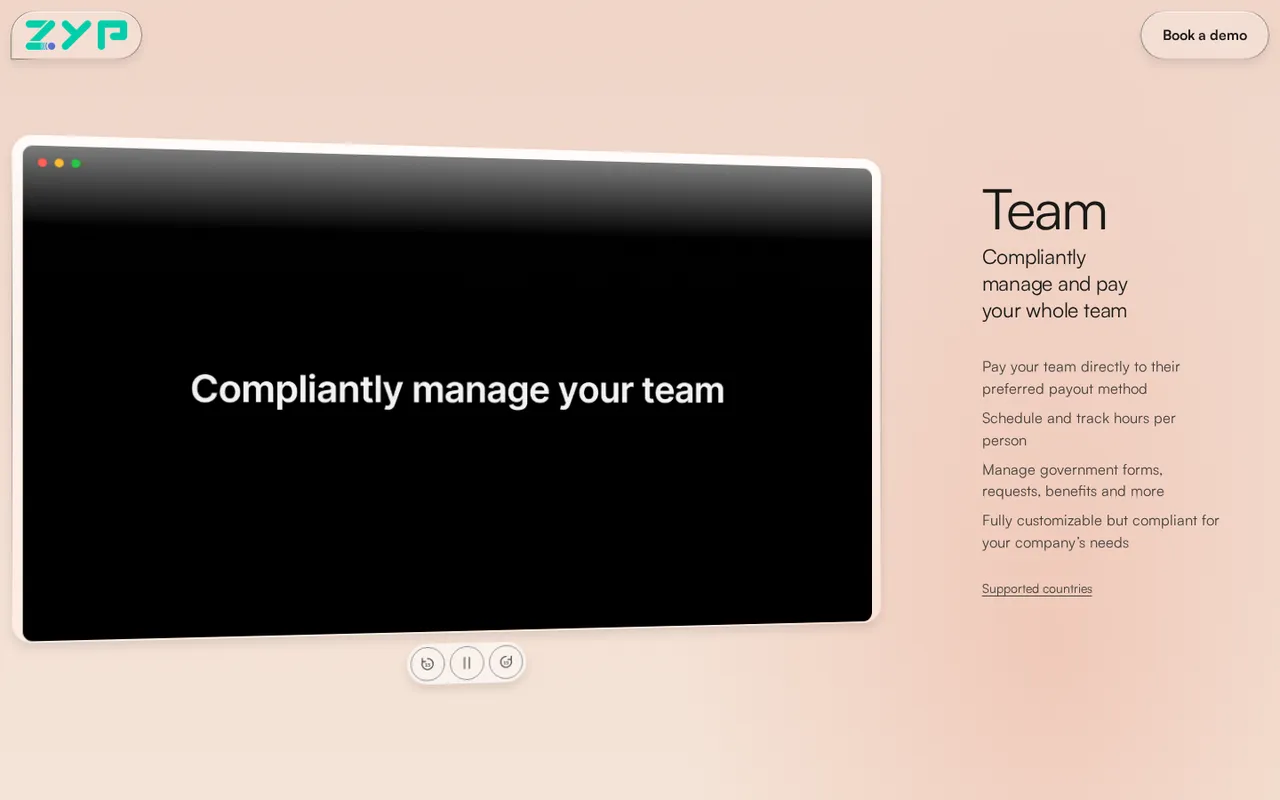
Everything below the hero is the same idea at a smaller scale: a little motion that explains, then stillness. The header is glass at rest and a solid surface the moment the page scrolls, which is what fixed its jank. The logos turn on a cylinder made of CSS transforms. The dashboard band counts up once. The films open at full size with a transport under them.



Measured
What the numbers said
Every claim about the page's speed came from a tool, not a feeling. The scroll stutter was found by tracing: the renderer was starving for decoded frames, 38 misses in 54 ticks, with image decode the top cost in every run. The fix was measured on a scrub bench, and the budgets were written down so the next change had something to be held to.
Lighthouse ran on a local preview build; the frame and memory numbers are from headless Chromium on a four-core machine, for comparison with each other.
Process
How the work ran
Every stage started as a written brief: the goal, what was in and out of scope, the rules that applied, the edge cases on phones and under reduced motion, and how it would be verified. I ran the implementation of those briefs through coding agents and reviewed every diff myself against the thirteen rules; the architecture, the diagnosis and every merge were mine.
Nothing that touched the pinned hero or the scroll merged without the Safari gate: the build on my own iPhone, in real Safari, scrolled fast and slow with the address bar collapsing and returning. A headless browser never caught what that did.
The company's side ran as a written request log, each item with what it unblocked; a call became a pull request; a change proposed from their side was reviewed, used as the spec, and rebuilt on the production base.
What I learned
People come to a company's public site for the product, not for the effects. Motion there has to carry the message and then step aside, so the interesting decisions were about what moves, how far and when, more than how. The rest was discipline: write the rules first, measure before claiming, and test on the one device that matters before merging.